

Durable Leash for Two Dogs: 2026 Buying Guide
Table of Contents
- What Makes a Durable Leash for Two Dogs Last
- Double Dog Leash Configurations Compared
- How to Choose a No-Tangle Leash for Two Dogs
- Picking a Double Dog Leash for Large Dogs
- The Best Leash for Dogs That Pull: Control Features That Matter
- Matching One Leash to Two Different Dogs
- Care, Cleaning, and Weather Resistance
- Safety Checks and Failure Prevention
- Frequently Asked Questions
Last Updated: October 9, 2026
What Makes a Durable Leash for Two Dogs Last
A durable leash for two dogs is a single walking system built around a swivel connection, reinforced stitching, and hardware rated for twice the combined pull of both animals.
Walking two dogs at once multiplies every force on the gear. One dog lunges left while the other pulls right, and the junction point absorbs both loads at once, the weak link behind most leash failures.
Below: what holds up, which configurations suit which pairs, and how to spot failure points before they snap.
Hardware That Survives Daily Walks
Metal hardware decides how long a two-dog leash lasts. Look for a swivel snap rated for pulling dogs, not a decorative clip.

- Swivel connection: A rotating joint at the junction stops the two leads from twisting into each other. Without one, a tangle forms within minutes.
- Snap attachment: Spring-loaded snaps in stainless steel or zinc alloy outlast thin stamped clips by a wide margin.
- Leash clip size: A small clip on a large dog is a failure waiting to happen. Match clip strength to the heavier dog.
The swivel is the part most buyers overlook, and the part that prevents the tangle-free walking you paid for.
Stitching, Webbing, and Wear Points
Reinforced stitching at every stress point is the clearest sign of durable construction. Box stitching, not single-line stitching, is what you want at the handle and each connection point.
Wear shows up in predictable places: where the webbing meets the hardware, where the two leads join, and along the handle grip. Check those three spots monthly. A frayed stitch there means the leash is close to failing.
Double Dog Leash Configurations Compared
Double dog leash configurations fall into three families: couplers, dual leads, and retractable dual-line systems. The difference is where the load path splits and whether each dog can move at its own pace.
| Configuration | How the Load Path Works | Best For | Main Trade-Off |
|---|---|---|---|
| Leash coupler | One main lead ends in a ring or swivel; two short extensions branch from that single junction | Calm dogs that walk at the same pace and stay near each other | No independent length control; both dogs share one pivot point |
| Dual lead | Two full-length leads joined at the handle by a shared ring or a swivel block | Dogs of different sizes or speeds | More webbing to manage; the join point is the failure hotspot |
| Retractable dual-line | Two independent retracting lines inside one handle, each with its own brake and lock | Variable pace, sniffing, and stop-and-go walking | Moving parts (springs, spools, brake tabs) need cleaning and eventual replacement |
A leash coupler is the simplest and lightest option, and the most tangle-prone, because both dogs pivot around one fixed junction. A dual lead gives each dog more room, but you manage two full lengths of webbing.
Couplers, Dual Leads, and Retractable Systems
The right pick depends on how differently your dogs walk and how much load travels through a single junction.
Couplers. A coupler concentrates both dogs' pull into one ring or swivel, efficient when the dogs walk shoulder to shoulder, punishing when they do not.
Dual leads. A dual lead splits the load at the handle rather than a mid-lead junction, so each dog's line runs its own path to your hand.
Which Configuration Fits Which Pair
- Two calm dogs, similar size, similar pace: coupler. Lightest setup, fewest parts, least to manage.
- One large dog and one small dog: dual lead. The size mismatch makes a shared junction unsafe, because the larger dog's lunge travels straight into the smaller dog's collar.
- One puller and one relaxed walker: dual lead or retractable dual-line. You need independent length on at least one side so the puller's surges do not jerk the other dog.
leash and tether safety guidance
The Junction Is the Decision
Every configuration above fails or succeeds at the same place: where the two lines meet. A coupler has one junction mid-lead, a dual lead has one at the handle, and a retractable system has two, one per spool housing. Count the junctions in any setup and pick the one with the fewest and the strongest, that separates a two-dog leash that lasts from one that spends its life in a drawer.
How to Choose a No-Tangle Leash for Two Dogs
A no-tangle leash for two dogs needs a swivel at the junction, independent line paths, and a handle that keeps both leads separated at your hand.
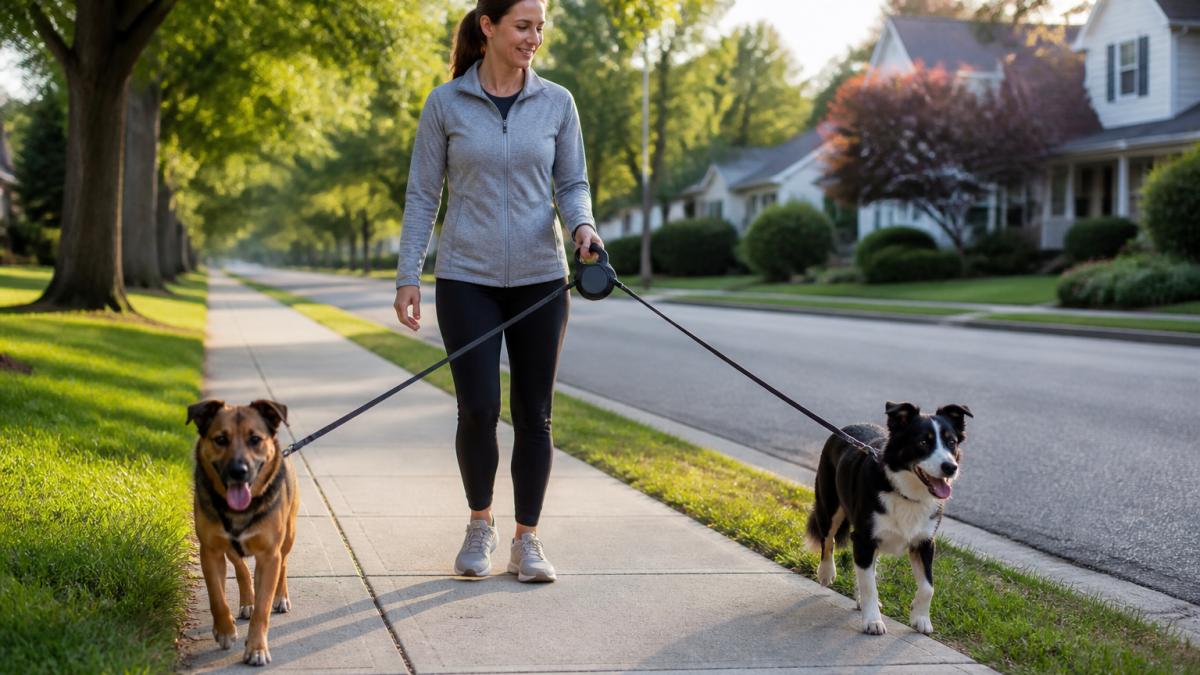
Start with the swivel, which lets each dog circle without winding the leads together.
Picking a Double Dog Leash for Large Dogs
A double dog leash for large dogs must be rated for the combined weight and pull of both animals, not each one separately. Weight capacity is the number to check first, and most failures come from ignoring it.
Here is the math most buyers skip. A relaxed 80-pound dog walking at heel puts roughly its own body weight of static load on the leash; the same dog hitting the end of the line at a trot can momentarily load the gear with several times that.
Reading the Ratings Before You Buy
Manufacturers rarely publish a single "two-dog" load rating, so read the components.
- Snap and clip ratings. Look for a stated working load on the snap, not just a material name. Stainless steel and zinc alloy snaps outlast thin stamped clips, but material alone does not give you the rating. No load figure at all is a warning sign.
- Swivel construction. A swivel that turns freely under hand pressure is the minimum. One that binds when you twist it will bind harder under two dogs, and a seized swivel transfers twist into the webbing, where fraying starts.
- Webbing width. Wider webbing spreads load across more stitches and resists cutting into your hand. For two large dogs, thin webbing is the first thing to fail at the handle.
Matching the Leash to the Heavier Dog
A common mistake is sizing the leash to the average of the two dogs. Size it to the stronger one, then confirm the setup is safe for the lighter dog.
- Weight capacity: Add both dogs' weights, then add a margin for pull force. If the total lands near a listed limit, step up to the next tier.
- Clip size: Match the clip to the heavier dog. A small clip on a large dog is a failure waiting to happen, and it is also the clip most likely to pop open mid-lunge.
- Junction strength: On a dual lead, the handle join carries both dogs' combined load. On a coupler, the mid-lead junction does. Inspect that point first, every time.
When a Double Leash Is the Wrong Tool
A double leash is not automatically safer than two separate leashes. Skip it, or split the dogs onto separate leads, when:
- One dog is more than roughly twice the weight of the other, and both pull.
- Either dog has a history of redirecting onto the other dog when frustrated or startled.
- You are walking near traffic, and you cannot physically hold both dogs back with one hand.
A Quick Field Test Before the First Walk
Clip both dogs on in a fenced area, not the street. Walk a few steps, then have a helper gently pull each dog's line in turn while you hold the handle. Watch the junction, swivel, and handle stitching under load. If anything stretches, twists, or clicks, you have found the weak point before a real lunge does. Repeat monthly and after every wet or muddy walk.
The Best Leash for Dogs That Pull: Control Features That Matter
The best leash for dogs that pull combines shock absorption with a second handle near the collar. A bungee section absorbs the initial jolt, reducing wrist strain and keeping you upright when a dog hits the end of the line. A second, lower handle lets you pull a dog close at crosswalks and driveways without reeling in the full length, the most underrated control feature on a two-dog setup, letting you shorten one side instantly while the other dog stays comfortable.
Matching One Leash to Two Different Dogs
Dogs of different sizes or walking behaviors need a leash that adjusts per side. Fixed-length couplers struggle here, because a fast dog drags a slow one.
For a size mismatch, choose a dual lead or a retractable system where each line moves independently. For a behavior mismatch, one puller and one relaxed walker, look for adjustable length on at least one side and a swivel at the junction.
Care, Cleaning, and Weather Resistance
Weather resistance comes down to material. Leather leash options need conditioning and dislike prolonged wet conditions; nylon leash and rope leash options tolerate rain better but can hold grit in the weave. Clean webbing with warm water and mild soap, then air dry away from direct heat.
Inspect after every wet or muddy walk. Grit trapped in the swivel is the most common cause of a stiff, sticking connection.
Safety Checks and Failure Prevention
Run a quick inspection before every walk, thirty seconds catches most failures before they happen.
- Check the swivel turns freely
- Look for frayed stitching at the handle and junction
- Confirm both snaps close fully and lock
Replace the leash at the first sign of a failing stitch or a sticking swivel. A repaired weak point on a two-dog leash is a temporary fix at best.
Our Auto Double Dog Leash ($26.25) is designed for this job. It uses a dual-head design so each line extends independently up to 3 meters for tangle-free control, a retractable telescopic system for adjustable length, durable ABS construction for daily wear, and an ergonomic grip for long walks with energetic pets.
Frequently Asked Questions
What are the disadvantages of a double dog leash?
The main drawbacks are tangling when dogs cross sides, reduced individual control compared with two separate leashes, and added strain on your wrist if both dogs pull at once. Coupler-style setups also limit how far each dog can move independently. Retractable dual-lead designs solve some of this by letting each line extend on its own, but they still require you to manage both dogs as a pair rather than separately.
How do you keep two dogs from tangling on a double leash?
Swivel snaps at each connection point let the lines rotate instead of twisting around each other. Keep dogs on opposite sides of your body, shorten the extension length when they start crossing, and practice a steady walking pace so neither dog surges ahead. A no-tangle leash for two dogs with independent lines and a rotating connection point does most of the work, but consistent positioning on your part prevents most tangles before they start.
Are double dog leashes suitable for dogs that pull?
They can work, but the leash alone will not stop pulling. A double dog leash for large dogs or strong pullers needs reinforced stitching, metal hardware rather than plastic clips, and a padded handle to protect your wrist. Pair it with loose-leash training so the dogs learn to walk at your pace. If both dogs lunge at once, a single-handle setup transfers that force directly to your arm, so control features matter more than length.
What features make a durable leash for two dogs last longer?
Look for reinforced stitching at every stress point, a swivel snap that rotates freely without sticking, and webbing or rope that resists fraying from repeated friction. Metal clips outlast plastic ones, and padded handles reduce wear on both the leash and your hand. Rinsing off mud and drying the leash fully after wet walks prevents the rot and stiffness that shorten a leash's working life.
Walking two dogs at once should simplify your routine, not add a daily wrestling match with tangled leads. 0ne Less Thing and Apparel focuses on practical products that make everyday tasks easier, and our Auto Double Dog Leash delivers independent dual lines, a retractable telescopic design, and durable ABS construction in one compact tool. Shop all collections and find the gear that makes walking both dogs the easy part of your day.