

Kitchen Faucet Attachment to Prevent Splashing: 2026 Guide
Table of Contents
- Why Your Kitchen Sink Splashes and What a Faucet Attachment Fixes
- Faucet Aerator for Splash Reduction: How It Works and What to Look For
- Kitchen Sink Splash Guard Behind Faucet: When You Need One and How to Choose
- How to Install a Faucet Sprayer Attachment: Step-by-Step
- Water Pressure, Flow Rate, and Splash Zone: What Actually Changes the Mess
- Material and Durability: Silicone, Metal, and Long-Term Wear
- Compatibility and Troubleshooting: Thread Adapters, Gaskets, and Universal Fit
- Pricing Breakdown and Product Pick: 1080° Rotatable Faucet Extender
- Frequently Asked Questions
Last Updated: September 30, 2026
Why Your Kitchen Sink Splashes and What a Faucet Attachment Fixes
A kitchen faucet attachment to prevent splashing is a small add-on that changes where water lands, not how much comes out. A kitchen faucet attachment to prevent splashing is a small add-on that changes where water lands, not how much comes out. The physics are simple: a standard faucet releases a hard, narrow stream. Hit a flat plate or a shallow bowl, and water ricochets sideways across your countertop and shirt. The physics are simple: a standard faucet releases a hard, narrow stream. Hit a flat plate or a shallow bowl, and water ricochets sideways across your countertop and shirt.
A faucet attachment fixes this in three ways. It lowers the water's exit point, it mixes air into the stream, and it angles the flow toward the basin instead of the rim. That combination shrinks what plumbers call the splash zone, the radius around the drain where water escapes the sink.
Most people blame themselves for the mess. They shouldn't. The EPA WaterSense program guidance on faucets and flow notes that standard faucets deliver water at a fixed angle and pressure, which is exactly what sends droplets flying.
Here's what most guides get wrong: they tell you to just turn the tap down. That helps, but it doesn't fix a stream hitting a plate at the wrong angle. Below, we'll show you exactly which attachment solves which problem, and how to install one in under a minute.
Faucet Aerator for Splash Reduction: How It Works and What to Look For
A faucet aerator for splash reduction works by pulling air into the water stream as it leaves the spout. Inside the aerator, water passes through a small screen or mesh, and the pressure drop across that mesh draws air in through side holes. The result is a softer, fuller, bubbly flow that lands with less force and spreads across a wider area instead of ricocheting off dishes.
The spec that actually controls splashing is the flow rate, measured in gallons per minute (GPM). A standard kitchen faucet without an aerator can run 2.2 GPM or higher. Most anti-splash aerators are rated between 1.5 and 1.8 GPM. Lower GPM means less water hitting the plate per second, which shrinks the splash zone without making the tap feel weak, because the entrained air keeps the stream looking and feeling full.
Four things matter when you pick one:
- Aerated versus non-aerated. Aerated models add air for a gentle, bubbly stream and the best splash control. Non-aerated (laminar) models keep a smooth, quiet stream that looks cleaner but splashes harder on impact. Laminar is common in healthcare and lab settings; aerated is what you want in a kitchen.
- GPM rating. Look for the number stamped or printed on the aerator body. A 1.5 GPM aerator cuts splash noticeably versus a 2.2 GPM stock insert. Going below about 1.2 GPM starts to feel like a trickle for rinsing.
- Thread size. Most residential kitchen faucets use one of two standard thread sizes: M22 (about 22 mm outer thread, common on many US faucets) or M24 (about 24 mm, common on European and some imported spouts). Some faucets use a proprietary or non-threaded spout and need an adapter. Measure before you buy.
- Gasket and mesh quality. A worn gasket is the number one cause of drips and wobble after installation. A clogged or coarse mesh weakens the aeration and lets the stream hit harder.
A common mistake is buying an aerator by looks alone. The chrome finish matters less than the internal mesh and the rubber gasket that seals it. In practice, a cheap aerator with a good gasket and the right GPM outperforms a costly one with a poor seal.
Kitchen Sink Splash Guard Behind Faucet: When You Need One and How to Choose
A kitchen sink splash guard behind faucet is a barrier that catches water before it reaches the wall or countertop behind the sink. You need one when the back of your sink sits against drywall, a painted surface, or a cabinet that swells with moisture.
Two main types exist. Silicone mats sit flat on the counter and channel drips back into the basin.
1080° Rotatable Faucet Extender →
| Problem | Best Fix | Why |
|---|---|---|
| Water pools behind faucet | Splash guard behind faucet | Catches and redirects standing water |
| Water sprays sideways | Faucet aerator | Softens the stream at the source |
| Water misses the basin | Rotatable extender | Repositions flow over the sink |
| Drips after shutoff | New gasket seal | Stops leaks at the connection |
How to Install a Faucet Sprayer Attachment: Step-by-Step
Installing a faucet sprayer attachment takes about two minutes and needs no tools in most cases. Here's the process we walk customers through.
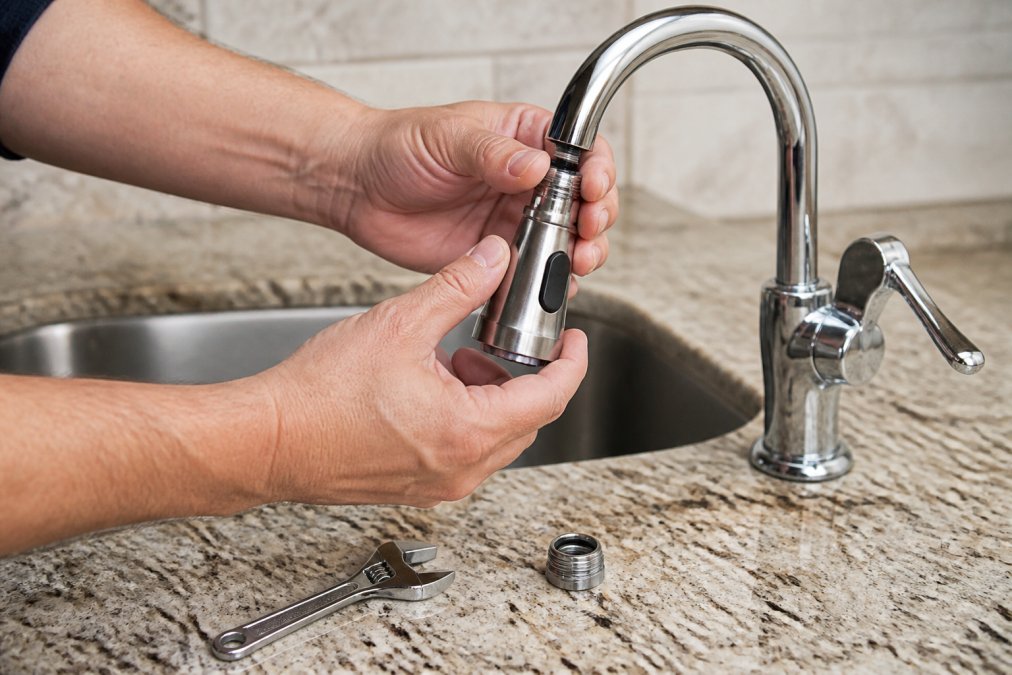
- Shut off the water and open the tap to release pressure.
- Unscrew the existing aerator by hand. If it's tight, wrap it with a cloth and use pliers gently.
- Check the thread and fit your adapter if needed.
- Insert the gasket into the new attachment before threading it on. Skipping this causes leaks.
- Hand-tighten the attachment. Don't over-tighten; you can crack plastic threads.
- Turn the water on slowly and check for drips at the joint.
- Test both modes if your attachment has a stream and spray setting.
Water Pressure, Flow Rate, and Splash Zone: What Actually Changes the Mess
Water pressure is the force pushing water through your pipes; flow rate is how much water comes out per minute. High pressure with a narrow opening creates the worst splashing, because the stream hits dishes at speed.
Material and Durability: Silicone, Metal, and Long-Term Wear
Silicone and metal attachments fail in different ways, and knowing which suits your sink saves a repeat purchase. Silicone resists hard water buildup and won't scratch finishes, but it can stretch over time. Metal holds its shape and looks sharper, though chrome finish can pit if you leave acidic cleaners on it.
Compatibility and Troubleshooting: Thread Adapters, Gaskets, and Universal Fit
Compatibility is where most installations fail, and it's the part retail listings gloss over. "Universal fit" is a marketing phrase, not a standard. Faucet threads vary, and a universal attachment often ships with adapters for the most common sizes only.
- About 22 mm = M22 thread (common on many US kitchen faucets).
- About 24 mm = M24 thread (common on European and some imported spouts).
Troubleshoot in this order:
- Attachment won't thread on. Wrong thread size or missing adapter. Match the adapter to your spout's measured diameter, not to the attachment's box label.
- It threads but leaks at the joint. The gasket is missing, worn, or seated crooked. Replace it. A fresh rubber gasket costs a few cents and fixes most drips.
- It fits but wobbles. The thread is too shallow. A rubber washer can take up the gap and stop the wobble.
- Flow is weak after install. Debris or mineral scale is blocking the mesh. Descale it (see the maintenance section).
- It fits and seals but splashes worse than before. The attachment is laminar, not aerated, or the GPM is too high for your pressure. Swap to an aerated model in the 1.5-1.8 GPM range.
Pricing Breakdown and Product Pick: 1080° Rotatable Faucet Extender
Pricing for faucet attachments falls into three rough tiers, and the differences are about features, not just quality.
| Tier | Typical Cost | What You Get | Best For |
|---|---|---|---|
| Basic aerator | Under $10 | Fixed stream, single mode | Simple splash reduction |
| Mid-range aerator | $10-$20 | Aerated stream, swivel base | Most kitchen sinks |
| Rotatable extender | Around $17 | Full rotation, dual modes | Hard-to-reach sinks |
Frequently Asked Questions
How to prevent a faucet from splashing?
Start by checking the aerator. A clogged or missing aerator sends a hard, narrow stream that hits the sink bottom and bounces back. Replace it with an aerated model, or add a 1080° rotatable faucet extender that lets you angle the stream toward the basin wall instead of straight down. Also lower the flow rate slightly and keep the nozzle closer to the sink floor.
Do faucet aerators actually reduce splashing?
Yes, when they mix air into the water stream. That aerated stream is softer and wider, so it spreads across the sink surface instead of hitting one spot and rebounding. A faucet aerator for splash reduction works best when the flow rate matches your water pressure. If pressure is very high, pair the aerator with a splash guard behind the faucet to catch what still escapes.
What is a good faucet splash guard for a kitchen sink?
A good splash guard sits behind or around the faucet base and blocks water that would otherwise run down the counter. Look for a silicone mat or guard with a raised lip, a universal fit that works with standard faucet bases, and a material that resists hard water buildup. Silicone is easier to clean and descale than metal, and it will not scratch a chrome finish.
How do I know a faucet attachment will fit my sink?
Check the thread size on your faucet spout before buying. Most standard kitchen faucets use a threaded aerator, and many attachments include a thread adapter for non-standard sizes. Measure the outside diameter of the spout, confirm whether the threads are inside or outside, and look for a listing that mentions universal fit and includes a gasket seal. If the attachment wobbles or drips, the adapter or gasket is the wrong size.