

How to Untangle Multiple Dog Leashes: A Step-by-Step Guide
Table of Contents
- Why Multiple Dog Leashes Tangle So Easily
- How to Safely Separate Dogs with Tangled Leashes
- How to Walk Two Dogs Without Tangling Leashes
- Best Leash for Walking Two Dogs
- Common Mistakes to Avoid When Untangling Multiple Dog Leashes
- Safety Risks and When Not to Let Dogs Self-Untangle
- Frequently Asked Questions
Last Updated: October 15, 2026
Why Multiple Dog Leashes Tangle So Easily
Walking two dogs seems straightforward until you need to untangle multiple dog leashes wrapped around each other.
Busy walks make it worse: dogs stop to sniff, lunge at other animals, and weave between obstacles, creating new crossing points until the leashes are knotted tight.
Understanding why tangles happen helps you prevent them.
The right equipment and technique let you walk two dogs comfortably without constant untangling.
How to Safely Separate Dogs with Tangled Leashes
First, stay calm. Dogs read your body language, and an anxious handler makes anxious dogs. Take a breath, in most cases nobody is in danger; you just need to unwind the lines in the right order.
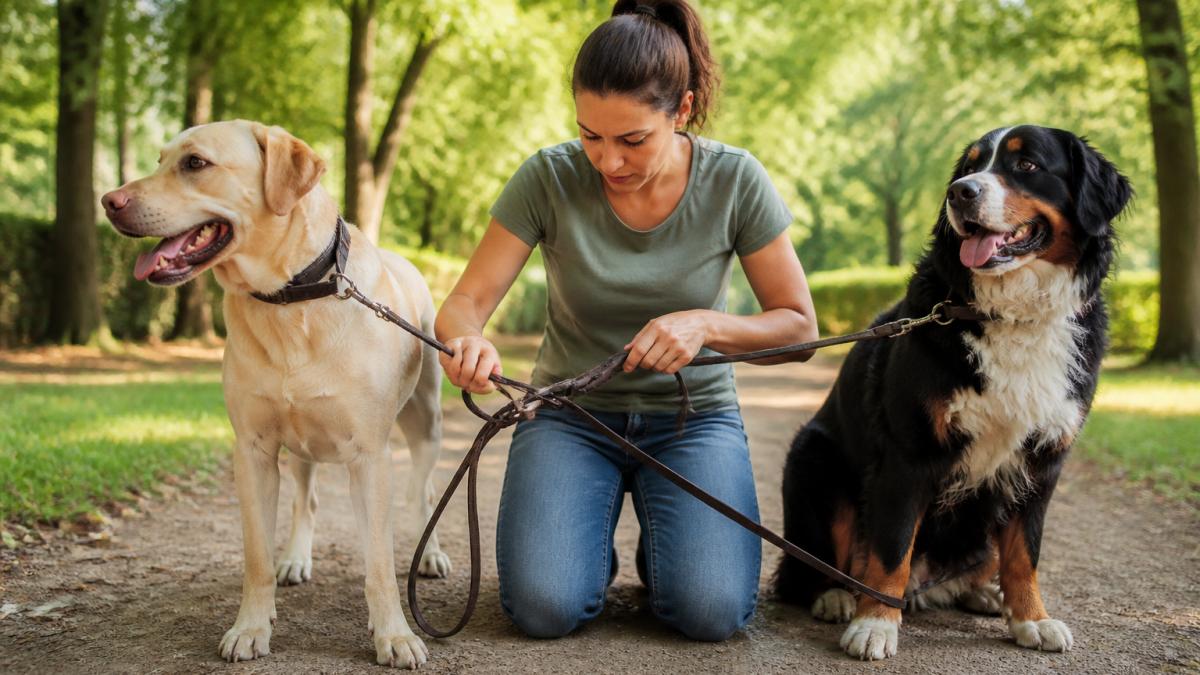
Step 1: Stop the Walk and Anchor Both Dogs
Stop moving before you touch a line, a walking dog tightens every crossing point. Plant your feet, shorten your grip so both leashes are snug but not tight, and let the dogs stand.
If you can, step on the slack of one leash with a flat foot. This is the most useful two-dog trick: your foot becomes a third hand holding one line steady while you work the other.
Step 2: Recognize the Tangle Pattern
Study how the leashes are wrapped before moving anything, the pattern tells you which line to move first.
Common patterns include:
- Simple cross, the two leashes cross once in an X between you and the dogs. The easiest fix: step toward the dogs and let the X fall out as you shorten your grip.
- Twisted rope, the leashes have spun around each other two or more times. You have to unspin them, not pull them apart.
- Leg wrap, one leash loops around a dog's back leg. Free the leg first; never pull the leash tight against the joint.
Ten seconds of study saves minutes later.
Step 3: Identify Which Leash to Move First
This step prevents making the tangle worse. Trace each leash from the clip at the collar or harness back to your hand, following the actual path of the line.
Ask yourself:
- Which leash crosses over the other?
- Which leash is wrapped around what?
- Can I move one without tightening the other?
The line that crosses on top is almost always the one to move first; moving the wrong one tightens the knot.
Step 4: Unwind the Leash Carefully
Once you know which leash to move, work slowly with gentle, steady movements, never yank.
Follow these steps:
- Hold one dog's collar or harness handle gently.
- Slowly back that dog away from the tangle.
- Watch the leash as it unwinds.
- Stop if it tightens.
- Adjust the dog's position and try again.
If the leash tightens, you're moving the wrong direction, reverse course and try forward or sideways instead.
For a twisted-rope tangle, don't pull the lines apart, unspin them. Hold both leashes near the clips and rotate your wrists in the direction that loosens the twist, as you would two twisted cords.
Step 5: Use Gentle Leash Pressure
Light pressure guides your dog without forcing. Never yank or jerk, a quick pull startles dogs and makes them pull back harder.
Apply steady, gentle pressure instead, a suggestion, not a command.
This works best when your dog knows basic leash training; if they pull constantly, work on that before attempting complicated untangling.
Step 6: Free a Leg or Body Wrap Safely
Leg and body wraps are the ones most likely to cause injury, so they get their own sequence.
- Support the wrapped limb or the dog's chest with one hand so the leash isn't bearing weight against the joint.
- Slide the loop down and off the paw rather than lifting it up over the body.
- If the loop is too tight to slide, back the dog out of it by walking them backward in a slow arc.
- Never lift a wrapped leash over a dog's head, that tightens it across the throat.
If a leash is wrapped around a dog's neck, treat it as an emergency. Support the dog's weight, take pressure off the throat immediately, and cut the leash if you can't free it in a few seconds.
Step 7: When to Ask for Help
If you can't separate the lines in about 30 seconds, or either dog is panicking, ask a nearby person to hold one dog while you work, a second set of hands turns a frustrating tangle into a 10-second fix. If no one is around and a dog is in distress, call for help rather than struggling alone.
How to Walk Two Dogs Without Tangling Leashes
Prevention beats fixing tangles every time. The right positioning, hand mechanics, and equipment keep leashes from crossing, and determine whether you spend your walk untangling or enjoying it.
Positioning and Spacing
Keep your dogs on opposite sides of your body, one left, one right, to spread them out and prevent their leashes from crossing.
Maintain distance between them:
- At least 2 feet apart on a normal sidewalk.
- More space on busy sidewalks or near other dogs.
- Less space in quiet, open areas where you can see what's coming.
Hand Mechanics: The Part Nobody Explains
How you hold the leashes matters more than how far apart the dogs walk.
- Two hands, two leashes gives you the most independent control. Hold the left dog's leash in your left hand and the right dog's leash in your right. Your arms act as separate shock absorbers, so one dog's lunge doesn't yank the other.
- One hand, both leashes is convenient but couples the dogs. If one pulls, the other feels it. If you use one hand, keep the leashes on the same side of your body and let a little slack pool in your palm so a sudden pull doesn't transfer.
- Waist belt with two clips frees both hands and keeps your center of gravity low, which helps with strong pullers. The trade-off is that you can't independently shorten one line in a hurry.
Leash Length and Type
Leash length changes how often you tangle.
- 4-foot leashes keep dogs close and reduce the arc they can swing into each other. Best for busy areas.
- 6-foot leashes are the standard walking length and a good balance for two dogs.
- Long lines and retractable leashes give dogs more room to cross, wrap, and build speed into a tangle. They're the most common cause of serious multi-dog tangles.
If you walk two dogs regularly, two fixed-length leashes in the 4- to 6-foot range are the simplest tangle-reducing setup. Save the long line for solo training sessions.

Teaching a 'Fix It' Cue
Dogs can learn to untangle themselves, saving you time and teaching them leash awareness.
Start in a safe space like your yard:
- Gently wrap the leash around your dog's leg.
- Say "Fix it" in a cheerful voice.
- Reward them when they step out of the loop.
- Practice 5-10 times per session.
- Increase difficulty gradually.
Over time your dog learns what "fix it" means and will try to free themselves first on walks, reducing your work significantly.
Practice Drills for Two Dogs
You can build tangle resistance before you ever hit a busy sidewalk.
- Figure-eight drill: In a yard or empty lot, walk a figure-eight pattern with both dogs on opposite sides. This teaches them to hold their side even as your path curves.
- Pass-by drill: Have a helper walk a neutral dog past you while you keep both dogs on their sides. Reward calm behavior.
- Stop-and-stand drill: Practice stopping on cue and having both dogs sit while you shorten your grip. This is the exact motion you'll use when a tangle starts.
When to Use Two Handlers
Some pairs are safer with two people. If either dog is reactive, much larger, or prone to lunging, walk them separately or with a second handler, a two-handler walk eliminates most tangles entirely.
Best Leash for Walking Two Dogs
Equipment matters. The right leash setup prevents tangles and gives you better control.
Dual Retractable Leashes
A dual retractable leash walks two dogs with one handle. Each dog gets an independent 3-meter line, so the lines don't wrap around each other as easily.
The 0ne Less Thing and Apparel Auto Double Dog Leash uses this design: a telescopic system lets each dog explore while staying under control, and the ergonomic grip stays comfortable on long walks.
Key benefits:
- One handle for two dogs
- Independent line extension for each dog
- Durable ABS construction
- Compact and lightweight
It costs $26.25, works for various sizes, and its 3-meter reach gives freedom while keeping dogs manageable.
Individual Leashes with Proper Technique
Some owners prefer traditional leashes, one per dog gives more independent control.
Use these tips:
- Choose 4-6 foot leashes for better manageability
- Hold them in both hands for balance
- Keep dogs positioned on opposite sides
- Use the positioning and spacing techniques mentioned above
Individual leashes work fine with good habits, but managing two is the drawback; many owners find dual leashes simpler for everyday walks.
Common Mistakes to Avoid When Untangling Multiple Dog Leashes
Learning what NOT to do saves time and stress.
Yanking the leash hard. This frightens dogs and tightens knots; gentle, steady pressure works better.
Getting frustrated visibly. Dogs pick up on your emotions; stay calm and they'll settle down.
Letting dogs pull while tangled. Stop immediately, continued walking and pulling worsens things fast.
Skipping prevention entirely. Invest in training and proper equipment; prevention is far easier than constant untangling.
Safety Risks and When Not to Let Dogs Self-Untangle
Most tangles are harmless, but some require immediate attention.
Watch for these warning signs:
- A leash wrapped tightly around a dog's neck
- A dog showing signs of stress or difficulty breathing
- A leash cutting off circulation to a leg
- A dog becoming aggressive or panicked
Never leave a tangled dog unattended; always supervise.
For aggressive or extremely anxious dogs, walk them separately, one at a time is safer and less stressful for everyone.
Walking two dogs takes practice and the right tools.
The 0ne Less Thing and Apparel Auto Double Dog Leash makes walking two dogs easier.
Frequently Asked Questions
How do you untangle two dog leashes quickly?
Stay calm and keep both dogs still. Identify which leash wraps around which leg or obstacle. Gently unwind the leash that's on top, using light pressure to guide each dog to reposition. Avoid yanking or pulling hard, as this can frighten the dogs and tighten the knot. Most simple tangles separate in under a minute with steady, gentle movements.
What's the best leash for walking two dogs without tangling?
A dual retractable leash like the Auto Double Dog Leash ($26.25) is designed specifically for this. It features two independent lines that extend up to 3 meters each, allowing each dog to move freely without crossing paths. If you prefer separate leashes, keep them on opposite sides of your body and teach your dogs a 'fix it' cue to reposition when they cross.
Is it safe to let a dog untangle itself from a leash?
Only if the dog is calm and the tangle is minor. Anxious or aggressive dogs may panic and tighten the knot, risking injury. If your dog is pulling hard, lunging, or showing signs of stress, stop and untangle manually. Always supervise and avoid situations where a dog could wrap around obstacles like poles, trees, or other dogs' collars.
How do you prevent leashes from tangling when walking multiple dogs?
Position dogs on opposite sides of your body and maintain consistent spacing. Use a dual retractable leash to give each dog independent movement. Train a 'fix it' marker word that signals dogs to reposition when they start crossing. Practice walking in open areas first, then gradually move to busier environments as your dogs improve.