

Best Car Phone Mount for Potholes: What Actually Holds
Table of Contents
- Why Most Car Phone Mounts Fail on Potholes
- What Makes a Car Phone Mount for Rough Roads Actually Hold
- Windshield vs. Dashboard Phone Mount: Which Survives Bumps Better
- What Counts as the Strongest Car Phone Mount
- Safe Phone Mount Placement in a Car: Visibility, Airbags, and State Rules
- Mount Types Compared: Vent, Dashboard, Windshield, and Cup Holder
- How to Test a Mount Before You Trust It on Your Commute
- Mistakes That Send Your Phone Flying
- Frequently Asked Questions
Last Updated: October 7, 2026
Why Most Car Phone Mounts Fail on Potholes
Most car phone mounts fail on potholes because they were never designed for sudden vertical shock.
Failure shows up in one of three places: the suction cup loses its seal, the ball joint slips and tilts your phone toward the floor, or the magnetic hold weakens enough that a hard bump knocks the phone free.
Below, we break down what holds on rough roads, how to compare mount types, and how to test any mount before trusting it on a daily commute.
What Makes a Car Phone Mount for Rough Roads Actually Hold
A car phone mount for rough roads holds when three things work together: a strong attachment to the vehicle, a firm grip on the phone, and a joint that resists vibration. Miss one and the mount fails when you need it most.
Suction Strength and the Surface It Sits On
Suction mounts live or die by their surface. A smooth, non-porous windshield gives a suction cup the best chance to hold, while a textured or curved dashboard makes a seal much harder to maintain as temperatures swing.
Look for a suction mount with a lever or twist mechanism to tighten the seal, plus a gel or reusable pad that grips uneven surfaces. Some designs add a non-slip mat for dashboard stability.
Magnetic Hold, MagSafe Compatibility, and Phone Case Fit
Magnetic mounts trade a cradle for a magnet, so the hold depends on the phone or case. MagSafe compatibility makes this predictable: a MagSafe phone or case snaps into alignment and holds firmly.
A thick case weakens the magnetic connection. If the phone shifts on the magnet during normal driving, it will slide on a bump.
Windshield vs. Dashboard Phone Mount: Which Survives Bumps Better
The surface in your specific car decides more than the mount type. A windshield mount usually survives bumps better because glass is smoother, flatter, and non-porous, but that advantage disappears if your windshield is heavily curved, you park in direct sun, or your state restricts windshield mounting. Dashboard mounts win on reach and discretion but depend heavily on the dash's texture and shape.
Match the mount to your actual surface
| Your surface | Best attachment | Why | Main risk |
|---|---|---|---|
| Smooth windshield glass | Suction cup with a locking lever | Non-porous, flat, strong seal | Heat and sun exposure over time |
| Textured or pebbled dash | Adhesive base or a large non-slip pad | Suction cannot seal on pores | Residue and adhesive softening in heat |
| Curved or padded dash | Cup-holder base or a weighted pad | Flat suction and adhesive both struggle | Sliding and limited viewing angle |
| Firm horizontal vent slats | Vent clip with a stabilizing leg | Slats give a mechanical grip | Slats flex and the clip loosens |
| Vertical or round vents | Avoid vent clips | No stable slat to grip | Clip rotates and drops the phone |
| Deep or narrow cup holder | Cup-holder base with an adjustable foot | Mechanical fit, no adhesion | Wobble if the base is undersized |
In practice, three variables decide the outcome: surface texture, cabin temperature, and phone weight with its case.
Why texture beats mount type
A suction cup holds by pulling a vacuum against a smooth surface. Every pore, ridge, or curve gives air a path back under the cup, so the seal bleeds off over hours or days, which is why a cheap suction mount can feel rock-solid on glass and fail within a day on a textured dash.
Why heat and cold change the answer
Cabin temperatures swing more than most people expect. A windshield mount in direct summer sun sits in the hottest part of the cabin, softening adhesive and weakening the suction seal; a dashboard mount has the same problem plus a hot, expanding surface underneath. Cold does the opposite: joints stiffen, adhesive loses tack, and a marginal seal can pop loose on the first cold morning.
Why phone weight and case thickness matter
A heavy phone in a thick case puts more leverage on the joint and more load on the attachment, and a long arm multiplies it, so a heavy phone on a long arm will lean on rough roads even if the base never moves. Keep the arm short, keep the phone close to the pivot, and test with the case you actually use.
A quick decision path
- Smooth glass, want maximum hold: windshield suction mount with a locking lever, parked out of direct sun when possible.
- Textured or curved dash, want low profile: adhesive base or a weighted non-slip pad, not a bare suction cup.
- Firm horizontal vent slats, want easy reach: vent clip with a stabilizing leg, checked for slat flex.
Placement still has to be safe
Whichever type you choose, keep the phone out of the airbag zone and your sightline. Never mount it directly over a steering wheel airbag or in front of a passenger-side airbag panel, and keep it low and to the side so it doesn't block the road. Distracted-driving laws vary by state, and several restrict windshield mounting or phone use while driving, so check your state's driver handbook or motor vehicle department before you mount anything.
What Counts as the Strongest Car Phone Mount
The strongest car phone mount matches your car's interior and your phone, not the biggest magnet or longest arm. Strength comes from a secure attachment, a firm grip, and a joint that stays put under vibration.
When you compare options, weigh these factors:
- Attachment method: suction with a locking lever, adhesive base, vent clip, or cup-holder base
- Grip style: magnetic hold, adjustable side grips, or a padded cradle
- Joint quality: a stiff ball joint resists leaning; a loose one drifts
A mount with a strong magnet but a flimsy joint will still let your phone lean on rough roads. Balance matters more than any single spec.
Safe Phone Mount Placement in a Car: Visibility, Airbags, and State Rules
Safe phone mount placement in a car keeps your phone within easy sight without blocking your view or sitting in front of an airbag.
Adjustable Car Mount Magnetic Phone Holder →
Two placement rules matter most:
- Keep it out of the airbag zone. Never mount a phone directly over a steering wheel airbag or in front of a passenger-side airbag panel. A deploying airbag can turn a mounted phone into a projectile.
- Keep it out of your sightline. A mount that blocks part of your view creates a distraction and, in many states, a legal problem.
Distracted-driving laws vary by state, and several restrict windshield mounting or phone use while driving. Check your own state's driver handbook or motor vehicle department for current requirements before you mount anything.
Mount Types Compared: Vent, Dashboard, Windshield, and Cup Holder
Each mount type fits a different car and driving style. Vent mounts are compact and easy to reach, but slats flex and loosen the clip over time. Dashboard mounts sit close to the driver but struggle on textured or curved surfaces. Windshield mounts hold well on glass but take direct sun. Cup-holder mounts are stable but limit your viewing angle.
Here's how we'd match a mount to a setup:
- Smooth dash, want low profile: a dashboard mount with a non-slip base
- Glass-heavy cabin, want max hold: a windshield suction mount with a locking lever
- Magnetic phone or case: a magnetic mount, ideally MagSafe-compatible
How to Test a Mount Before You Trust It on Your Commute
Most reviews test a mount by shaking it in a hand or tapping it on a desk, which tells you nothing about how it behaves when a pothole sends a sharp vertical jolt through your suspension. What follows is a repeatable, low-cost test you can run in about 20 minutes on public roads with your phone and a few household items, a pass/fail result you can compare across mounts instead of a vague "it felt solid."

Set up a repeatable route
Pick a short loop you can drive the same way each time. A good route has three things:
- One rough patch: a street with patched asphalt, broken pavement, or a known pothole you can approach at a consistent speed.
- One speed bump or driveway lip: a single sharp vertical input rather than a long washboard.
- One stretch of smooth road: a control segment so you can tell whether movement comes from the mount or from the road.
Drive the loop three times per mount, one pass isn't enough, since a suction seal or ball joint can hold once and slip on the second or third jolt. Note the speed you take each feature at (for example, 15 mph over the rough patch) so runs are comparable.
Measure movement instead of eyeballing it
You don't need instruments. Two cheap methods give you a number:
- Tape-line method. Before you drive, place a small strip of painter's tape on the mount arm and a matching mark on the phone or cradle. After each run, check whether the marks still line up. Any offset means the joint or grip moved.
- Photo method. Take a photo of the mounted phone from the driver's seat before the run and again after. Compare the two. A phone that has tilted toward the floor or rotated a few degrees is a fail, even if it never fell.
Record three outcomes per run: did the phone stay attached, did it shift position, and did the mount itself move on the surface. A mount that keeps the phone attached but lets it lean is still a fail for navigation, because you'll keep re-aiming it.
Run the checks in this order
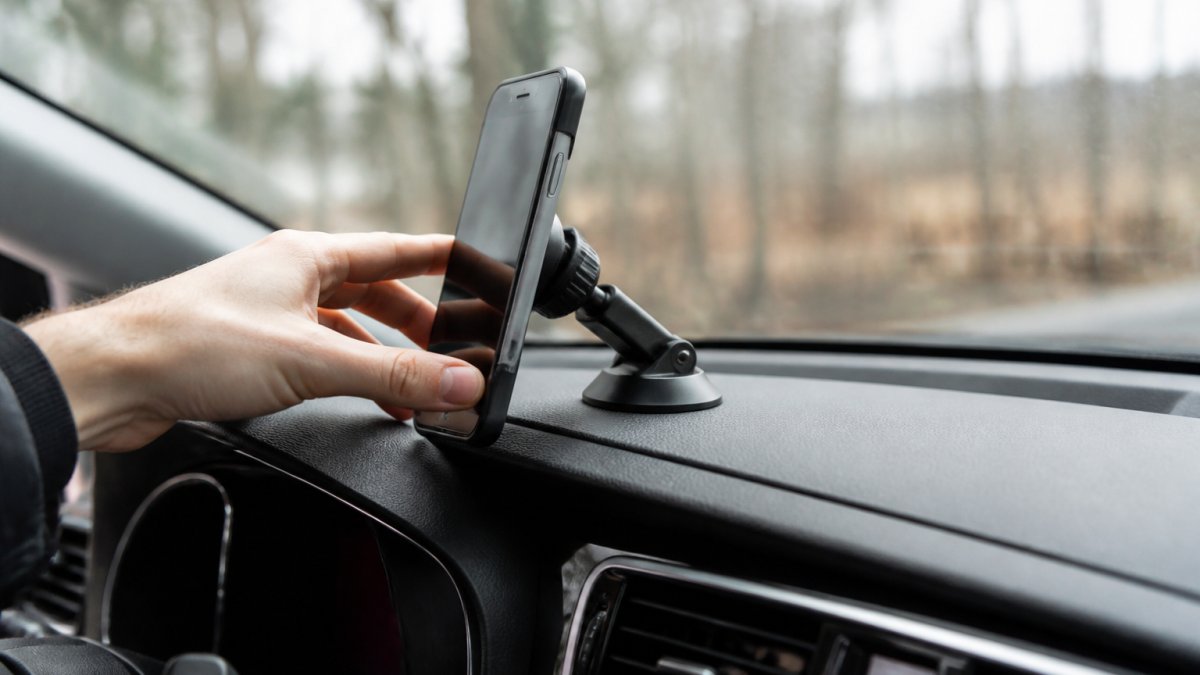
- Clean and dry the mounting surface, then let it sit for a minute before attaching the mount
- Press or twist the suction lever until the seal feels firm, and note how much travel the lever has left
- Attach your phone and confirm the grip feels tight, not loose
If the phone moves at any step, the mount isn't ready for daily potholes. A mount that holds through all three runs without a shift is one you can trust.
What a pass actually looks like
A passing mount keeps the phone attached, keeps it aimed where you set it, and keeps its base fixed to the surface across all three runs. A mount that passes the smooth segment but fails the rough patch has a weak joint or grip; one that passes the rough patch but drifts on the speed bump has a weak attachment.
Re-test after the seasons change
A mount that passed in mild weather can fail in a heat wave or cold snap, since suction seals and adhesives behave differently as cabin temperatures swing and plastic joints stiffen or loosen. Re-run the short version of this test, one rough patch, one speed bump, after the first hot week and first cold week of the year.
Mistakes That Send Your Phone Flying
Small mistakes cause most phone drops, and they're easy to avoid.
- Mounting on a dirty or greasy surface. Dust and dashboard residue break a suction seal fast. Wipe the spot clean first.
- Ignoring the case. A thick or non-magnetic case weakens the hold. Test the mount with the case you actually use.
- Overloading the joint. A long, heavy arm with a heavy phone puts stress on the ball joint. Keep the arm short.
For a magnetic option built for bumpy roads, our Adjustable Car Mount Magnetic Phone Holder uses a strong magnetic hold and an upgraded non-slip mat for dashboard stability. If you want a suction design with adjustable force, the Mobile Phone Holder Double-Sided Car Mount Magnetic adds a rotating lever to fine-tune the seal and a 360-degree mount for the best navigation angle.

Frequently Asked Questions
Which car phone mount stays secure over potholes?
Mounts that combine a wide, gel-backed suction cup or a weighted non-slip dashboard base with strong magnets or padded side grips hold up best. The Adjustable Car Mount Magnetic Phone Holder, for example, uses an upgraded large non-slip mat for dashboard stability, while the Double-Sided Car Mount Magnetic uses a 16-magnet panel with 1.5KG of adsorption force. Avoid thin vent clips with short arms, since they amplify road vibration instead of absorbing it.
Is it better to mount a phone on the dash or windshield?
It depends on your interior. Windshields give a smooth glass surface that suction cups grip well, but heat and direct sun can weaken the seal over time. Dashboards sit closer to your line of sight, yet textured or curved dash surfaces need a non-slip mat or gel pad to stay put. For rough roads, a dashboard mount with a wide padded base often handles potholes better than a windshield arm that swings.
How do I stop my phone mount from falling off the dashboard?
Clean the mounting surface with alcohol before attaching anything, since dust and dashboard protectant both weaken adhesion. Press the base down firmly for a full minute, then let it sit for a few hours before adding your phone. If you use a suction mount, rotate the lever to increase suction pressure. A non-slip mat under the base adds grip on textured or curved dashboards where plain suction struggles.
Do magnetic car phone mounts hold a phone securely over bumps?
Yes, when the magnet array is large enough and your phone or case has a compatible metal plate or MagSafe ring. The Double-Sided Car Mount Magnetic uses 16 magnets with adsorption pressure between 18Kpa and 65Kpa, which keeps the phone attached during sharp braking and rough pavement. If your case is thick or non-magnetic, add the included metal panel so the hold stays consistent.
Rough roads expose every weak point in a phone mount, and the wrong one will drop your phone when you least expect it. At 0ne Less Thing and Apparel, we stock practical automotive accessories built to simplify your daily drive, including magnetic and suction mounts with strong holds and adjustable angles. Browse our automotive collection to find a mount that stays put on your commute.